
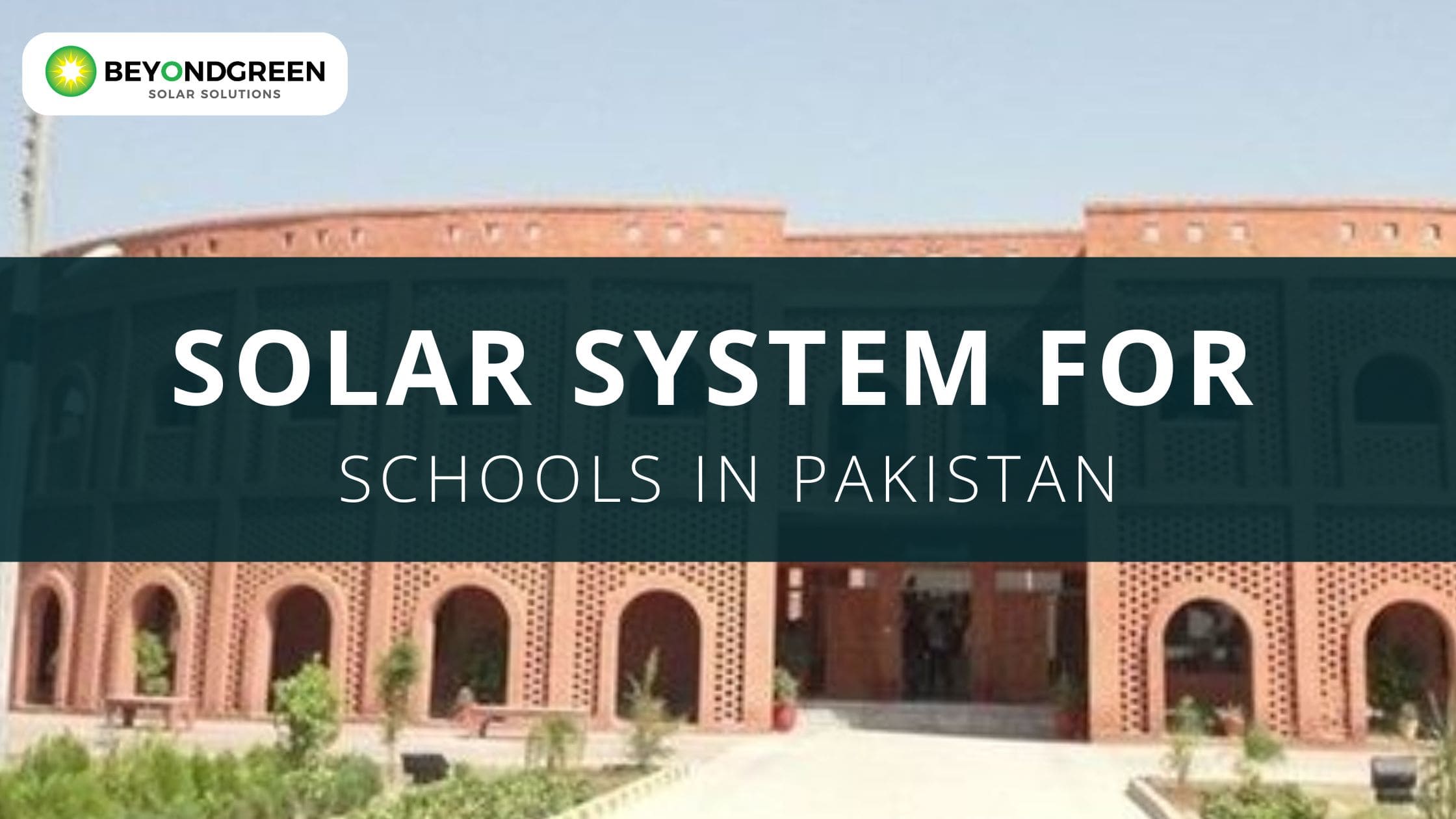
Solar System for Schools in Pakistan: How Danish School Went Solar with 1.08 MW
By the Beyond Green Solar Engineering Team | Updated September 2026
A solar system for schools in Pakistan is one of the smartest long-term investments an educational institution can make, and Danish School is a clear example. Beyond Green Solar designed, supplied and commissioned a 1.08 MW solar power system for Danish School, allowing the campus to generate a large share of its daytime electricity from the sun while reducing operating costs and its carbon footprint.
This case study covers why the school chose solar, how the system was delivered, and what other schools, colleges and universities can learn from the project.
Key Takeaways
- Beyond Green Solar installed a 1.08 MW (1,080 kWp) solar system at Danish School.
- The system is expected to generate roughly 1.6 to 1.8 million kWh of electricity per year.
- It is estimated to avoid 700 to 850 tonnes of CO₂ emissions annually.
- Installation was planned around the academic schedule to avoid disrupting classes.
- Schools are well suited to solar because most of their electricity is used during daylight hours.
Why Schools Are Investing in a Solar System in Pakistan
Electricity is one of the largest recurring expenses for any private school. Classrooms, computer and science labs, libraries, auditoriums and administrative offices all rely on lighting, fans, air conditioning and IT equipment, often for eight hours or more each day. With electricity tariffs regulated and revised by NEPRA and fuel-linked adjustments adding uncertainty to monthly bills, schools face constant pressure on their budgets.
A solar system for schools in Pakistan addresses this pressure in four ways:
- School hours match peak solar generation. Campuses use most of their electricity between morning and mid-afternoon, which is exactly when solar panels produce the most power.
- Large, usable roof space. School buildings, sports halls and covered parking areas provide wide roofs that suit large solar arrays.
- Stable operating costs. Lower electricity bills free up budget for teaching, facilities and student programmes rather than utility payments.
- A visible commitment to sustainability. Parents and students increasingly value institutions that act on climate and environmental responsibility.
The Challenge at Danish School
Danish School needed an energy solution that could significantly reduce its electricity costs without affecting the learning environment. The system had to meet the campus’s daytime demand, operate safely around students and staff, withstand Pakistan’s heat and dust, and be installed with minimal disruption to classes and school activities.
Schools also have a unique usage pattern. Demand is high on weekdays during term time but drops on weekends and during vacations. The system therefore had to be designed around the school’s real consumption profile, not just its roof size.
Our Solution: A 1.08 MW Solar System for Danish School
Beyond Green Solar delivered the project in four stages.
1. Energy Audit and Consumption Analysis
Our engineers reviewed the school’s electricity bills, load profile and daily timetable to understand when and how energy was being used. This analysis guided the system size and configuration, so that as much solar electricity as possible is used directly on campus.
2. Structural Assessment and Safe System Design
We assessed roof strength, orientation and shading across the campus buildings. Because the site is used by children every day, safety was the top design priority. The layout includes secure cable routing, restricted access to electrical equipment and clear maintenance walkways. Expected output was modelled using solar resource data from the World Bank’s Global Solar Atlas.
3. Installation Planned Around the School Schedule
Installation work was scheduled to minimise noise and movement during teaching hours, with safety barriers and supervision in place throughout. All mounting structures, cabling, protection devices and earthing were installed to international safety standards.
4. Grid Synchronisation, Testing and Handover
After installation, the system was synchronised with the campus power supply and tested for performance and safety. The school’s facilities team then received a full technical handover and guidance on operation, monitoring and maintenance.
Expected Results and Benefits
Based on typical performance for a 1.08 MW solar system in Karachi, the Danish School system is expected to deliver:
- Around 1.6 to 1.8 million units (kWh) of clean electricity per year, generated on campus.
- A major reduction in daytime grid consumption, lowering monthly electricity bills.
- Protection against future tariff increases, since solar generation cost is largely fixed once the system is installed.
- 25+ years of reliable performance from the solar modules, with low ongoing maintenance.
More Than Savings: Solar as a Learning Opportunity
A solar system for schools in Pakistan delivers value beyond the electricity bill. A working solar plant on campus gives teachers a real-world example for science, geography and environmental studies lessons. Live generation data from a monitoring system can help students understand energy, climate change and renewable technology in a practical way. For parents, a solar-powered campus is a visible sign that the school invests in the future its students will inherit.
Is a Solar System Right for Your School?
The Danish School project shows that megawatt-scale solar is practical and proven for educational institutions. Pakistan receives strong solar irradiation for most of the year, and the government’s Alternative Energy Development Board (AEDB) has long promoted renewable energy adoption across sectors. Globally, the International Renewable Energy Agency (IRENA) reports that solar PV is now one of the lowest-cost sources of new electricity generation.
Solar works especially well for:
- Private schools and school networks with multiple campuses
- Colleges and universities
- Madrassas and vocational training institutes
- Boarding schools and hostels
- Sports complexes and academic auditoriums
Whether your institution needs 50 kW or more than 1 MW, the right configuration depends on your daily load, roof space and vacation-period usage. You can compare hybrid, on-grid and off-grid options on our solar products page. For campuses with evening classes, hostels or critical loads such as server rooms, our guide to commercial battery storage in Pakistan explains how battery storage can extend solar savings beyond daylight hours.
Why Danish School Chose Beyond Green Solar
Since 2011, Beyond Green Solar has completed 5,000+ solar installations across Karachi, Lahore and Islamabad. As an AEDB-certified solar company, we bring proven experience in large-scale commercial and institutional projects:
- In-house design and engineering for residential, commercial, industrial and institutional solar
- Tier-1 solar modules and bankable inverters
- ISO 9001:2015 (quality), ISO 14001:2015 (environment) and ISO 45001:2018 (occupational health and safety) certified operations
- Safety-first installation practices suited to sites used by children and staff
- After-sales support, monitoring and O&M plans
See more of our institutional and commercial work on our projects page, or learn how to check whether a solar company is verified before you invest.
Frequently Asked Questions
How much does a solar system save a school in Pakistan?
Savings depend on system size, daily load and tariff, but because schools use most of their electricity during daylight hours, a well-sized solar system can offset a large share of daytime grid consumption. A 1.08 MW system like Danish School’s is expected to generate 1.6 to 1.8 million kWh per year.
How much electricity does a 1 MW solar system produce in Pakistan?
A 1 MW solar system in Karachi and most of southern Pakistan typically produces around 1.5 to 1.65 million kWh per year, or roughly 4,100 to 4,500 units per day on average, depending on season, orientation, shading and cleaning.
What happens to solar power during school holidays?
During weekends and vacations, school electricity use drops while solar generation continues. Depending on the system type, surplus energy can be exported to the grid where eligible, stored in batteries, or the system can be sized to match typical term-time demand. A proper energy audit determines the best approach.
Is solar safe to install on a school campus?
Yes, when designed and installed correctly. Professional installers use secure cable routing, protected electrical rooms, proper earthing and restricted access to equipment. At Danish School, Beyond Green Solar followed safety-first practices throughout design and installation.
How long does a school solar system last?
Quality solar panels typically last 25 years or more, while inverters usually last 10 to 15 years. With regular cleaning and maintenance, a school solar system delivers savings for decades.
Planning Solar for Your School?
Danish School’s 1.08 MW system shows how a solar system for schools in Pakistan can lower operating costs, protect budgets from tariff increases and create a greener campus for students. Contact Beyond Green Solar to book a free site survey and get a solar proposal tailored to your institution, or visit beyondgreensolar.com to explore our full range of solar solutions.