
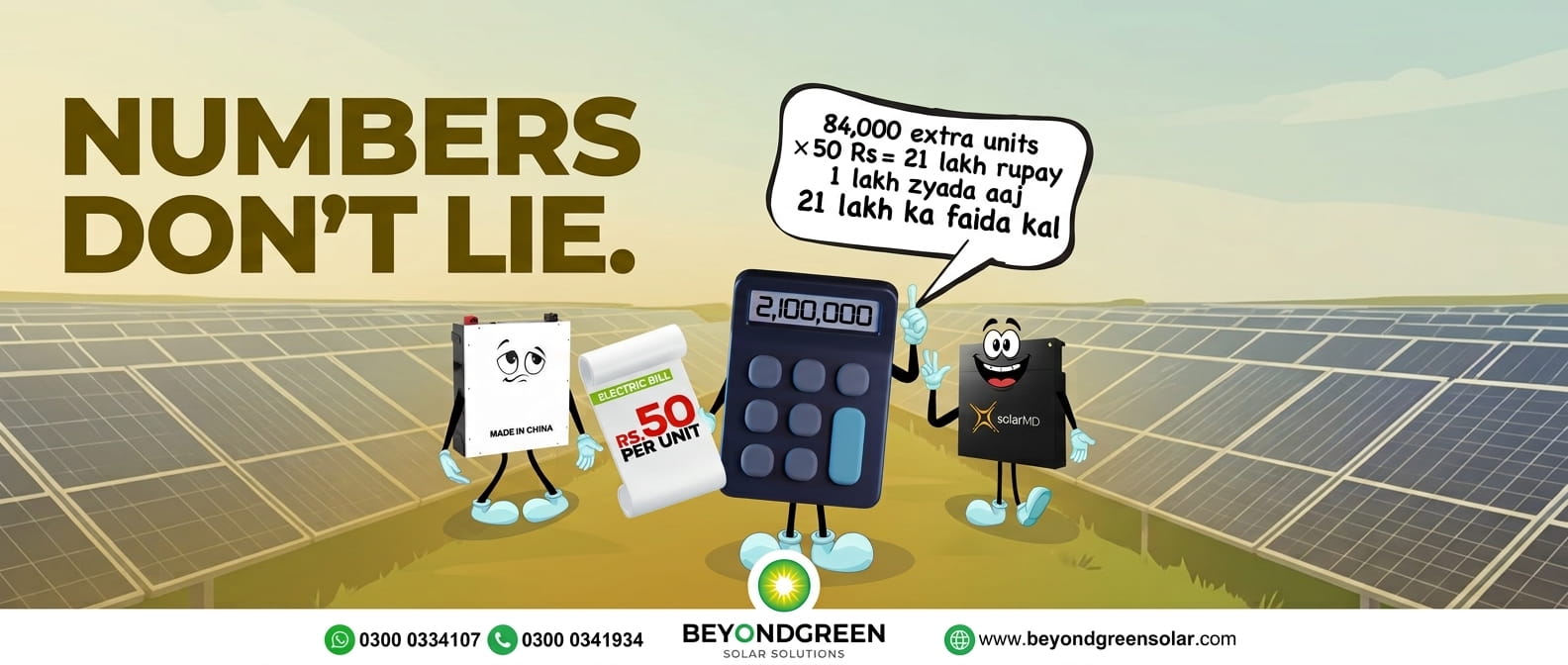
A solar ROI calculator Pakistan homeowners can trust needs three real numbers: your installed system cost, your self-consumption ratio, and today’s K-Electric or DISCO tariff — not a generic “solar pays for itself” claim. Since NEPRA’s net billing framework replaced 1:1 net metering in February 2026, the math changed for every existing formula floating around online. This guide breaks down exactly how to calculate solar ROI in Pakistan today, with worked examples for common system sizes and the current buyback rate built in.
The Solar ROI Calculator Pakistan Formula: How Payback Period Is Calculated
Every accurate solar ROI calculator Pakistan tool runs on the same underlying formula. It’s simple enough to do by hand once you have your numbers:
Payback Period (years) = Total Installed System Cost ÷ Annual Electricity Savings
The part people get wrong is “Annual Electricity Savings.” It isn’t just your old monthly bill times twelve. Under net billing, you earn two different rates depending on when your solar production is used:
- Self-consumed units: electricity yoursolar system generates and your home uses immediately. This saves you the full retail tariff — currently Rs 16 to Rs 70 per unit on K-Electric depending on your slab, with most households above the 200-unit protected threshold paying an effective Rs 45–65 per unit once FCA, QTA, and taxes are added.
- Exported units: surplus electricity sent to the grid when your panels produce more than your home is using. Since February 2026, this is credited at the net billing rate of approximately Rs 10–13 per unit — roughly half of what it was before the policy change.
So the full formula becomes:
Annual Savings = (Self-Consumed Units × Retail Tariff) + (Exported Units × Net Billing Rate)
This is why two identical 10 kW systems can have completely different payback periods. A home that’s empty from 9 AM to 6 PM exports most of its solar production and earns the lower rate. A home running ACs, water pumps, and a washing machine during the day self-consumes most of it and earns the full retail rate instead.
Solar ROI Calculator Pakistan: Sample Payback Periods by System Size
Running these numbers through the solar ROI calculator Pakistan formula above, here’s what the payback looks like in practice for three common residential system sizes, assuming a realistic 65% self-consumption ratio (running major appliances during daylight hours) and an effective retail tariff of Rs 45/unit:
These figures are for on-grid systems only. If you add battery storage for a hybrid solar battery backup system, expect the payback period to stretch to 3.5–5 years, since battery capacity adds significant upfront cost. What you gain in exchange is protection from load-shedding, which an on-grid-only system without batteries doesn’t provide.
What Changed for Solar ROI Calculator Pakistan Results Since Net Billing (February 2026)
Any solar ROI calculator Pakistan tool built before 2026 is now producing wrong numbers. In February 2026, the federal government replaced Pakistan’s old 1:1 net metering system with a net billing framework after regulators determined that widespread rooftop solar was reducing DISCO revenue. Under the previous rules, a unit you exported to the grid was credited at the same rate you paid to import — meaning your export and import cancelled out at full retail value.
Under net billing, exported units are now credited at the National Average Energy Purchase Price, which currently works out to roughly Rs 10–13 per unit — about half of the old rate. Import is still charged at the full slab-based retail tariff. Following public backlash, the government agreed to process applications submitted before February 8, 2026 under the old, more favourable rules; anything filed afterward falls under net billing.
The practical effect on your solar ROI calculator Pakistan result: oversizing a system to maximise export income no longer makes financial sense. The smarter approach in 2026 is sizing your system to match your daytime consumption as closely as possible, so more of your production is self-consumed at the full retail rate instead of exported at the lower net billing rate. For the full regulatory breakdown, see our updated net metering policy Pakistan 2026 guide.
5 Factors That Change Your Solar ROI Calculator Results
Beyond the formula itself, five variables swing your actual payback period up or down. Any solar ROI calculator Pakistan estimate you get from a vendor should account for all five, not just system size.
- Your self-consumption ratio. A household or business consuming most of its solar output during the day will always out-earn one that exports most of it, since self-consumed units save the full retail tariff instead of the lower export rate.
- Your existing tariff slab. A household already paying Rs 60–70 per unit on the top K-Electric slab sees a faster payback than one paying a subsidised Rs 16–20 per unit on the protected slab, simply because there’s more to save per unit displaced.
- Panel technology and degradation rate. N-Type TOPCon panels degrade roughly 0.4% per year versus 0.5%+ for older P-Type PERC panels, which preserves more output — and more savings — in years 15 to 25 of the system’s life.
- On-grid vs hybrid design. Adding lithium battery storage extends payback by 12 to 24 months upfront but adds load-shedding protection, which an on-grid-only system cannot provide.
- Financing structure. A cash purchase reaches payback fastest in raw terms, but Shariah-compliant financing options — like the Dubai Islamic Bank halal solar financing available through Beyond Green Solar — let you start saving from month one with no upfront cost, which changes the practical breakeven math even if the nominal payback period looks longer on paper.
How to Improve Your Solar ROI Calculator Pakistan Results
Since export income has dropped, the single biggest lever left in any solar ROI calculator Pakistan projection is maximising self-consumption. A few practical steps make a measurable difference:
- Run high-load appliances — washing machines, water pumps, geysers — during peak solar hours (10 AM to 4 PM) instead of the evening.
- Size your system to your actual daytime load using 12–13 months of billing history, not a single high-summer month, so you’re not building excess export capacity you’ll only get half-paid for.
- Consider a modest battery bank sized just for evening essentials (fans, lights, Wi-Fi, fridge) rather than a full backup system, which balances cost against self-consumption gains.
- Check your NEPRA-registered inverter and meter periodically — a miscalibrated bidirectional meter can under-credit your self-consumption and inflate your apparent export, silently working against your ROI.
For current panel and system pricing to plug into your own calculation, see our solar panel price in Pakistan today guide, updated with city-wise and brand-wise 2026 rates.
Frequently Asked Questions
What is a good solar ROI in Pakistan in 2026?
A well-sized on-grid residential system with strong daytime self-consumption typically pays back in 2.5 to 4 years under current net billing rules. Hybrid systems with battery storage usually take 3.5 to 5 years, trading a longer payback for load-shedding protection.
Does a solar ROI calculator Pakistan tool need to account for net billing?
Yes. Any calculator still assuming 1:1 net metering will overstate your export income and understate your payback period. Since February 2026, exported units are credited at roughly Rs 10–13 per unit instead of full retail value.
Is a bigger solar system always a better investment?
Not necessarily. Oversizing beyond your daytime consumption means a larger share of your production gets exported at the lower net billing rate. Right-sizing to your actual load usually produces a faster payback than maximising system capacity.
How accurate are online solar ROI calculators for Pakistan?
Only as accurate as the inputs. A calculator using generic national averages instead of your actual K-Electric or DISCO slab, your real monthly consumption pattern, and the current net billing rate will produce a rough estimate at best. A site-specific quote based on your last 12–13 months of bills gives a far more reliable number.
Get an Accurate Solar ROI Calculation for Your Home or Business
A generic solar ROI calculator Pakistan estimate is a starting point, not a substitute for a real site assessment. Your actual payback period depends on your roof orientation, your real consumption pattern, and your specific K-Electric or DISCO tariff slab — details a rule-of-thumb calculator can’t see.
Beyond Green Solar has completed over 10,000 installations across Pakistan and builds every quote from your actual billing history rather than national averages. Contact us for a free site assessment and a personalised ROI projection, or explore zero-upfront-cost halal financing to start saving without waiting to save up the full system cost. For official policy details, you can also review NEPRA’s regulatory updates and AEDB’s certified equipment and installer registry directly.